



For UK accounting professionals, the horizon is crowded with shifting goalposts. While the profession is perpetually adapting to incremental tax updates and digital mandates, the next two years promise a more structural transformation of the compliance landscape. Between sweeping regulatory changes aimed at reducing burdens on smaller businesses and complex updates to financial reporting standards, practitioners must prepare to guide their clients through a maze of operational adjustments. Yet, amidst this high-level regulatory evolution, the foundational, ground-level mechanics of bookkeeping—such as managing physical cash—remain as vital and challenging as ever.
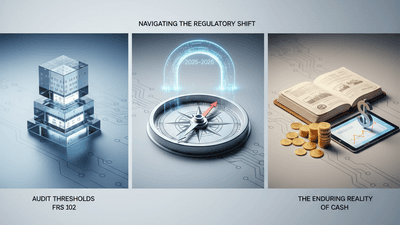
According to recent guidance on Current UK Accounting and Audit Updates Every Business Should Know, two major milestones are set to redefine the UK accounting environment: the alteration of audit thresholds effective April 2025, and the comprehensive update to Financial Reporting Standard (FRS) 102 effective January 2026. Navigating these macro-level shifts while maintaining rigorous micro-level controls will define the successful UK practice of the late 2020s.
The April 2025 Audit Threshold Uplift: A Double-Edged Sword
The UK government's push to cut red tape for small and medium-sized enterprises (SMEs) will culminate in a significant increase in the size thresholds that determine whether a company requires a statutory audit. Slated for April 2025, these changes are designed to free thousands of growing businesses from the financial and administrative burden of mandatory audits.
For SMEs, this is largely welcome news. For accounting practices heavily reliant on audit fees from businesses hovering around the current thresholds, it represents a critical juncture. The removal of the statutory mandate means that practices must proactively demonstrate the standalone value of assurance services, or pivot their service offerings.
Pivoting to Advisory and Voluntary Assurance
When the regulatory stick is removed, accountants must rely on the commercial carrot. Firms should begin segmenting their client base now to identify those likely to be exempted. The conversation needs to shift from compliance to commercial strategy. Voluntary audits or alternative assurance engagements (such as review engagements) can be positioned as vital tools for businesses seeking external investment, planning a future sale, or needing to satisfy stringent lender covenants.
"The lifting of audit thresholds isn't a loss of business; it's a catalyst for the UK accounting sector to transition from mandatory scorekeepers to essential strategic advisors."
The January 2026 FRS 102 Overhaul: Aligning with IFRS
Just as the dust settles on the new audit thresholds, practitioners will face the implementation of the revised FRS 102 in January 2026. This update is fundamentally about convergence—bringing UK GAAP closer to international standards, specifically IFRS 15 (Revenue from Contracts with Customers) and IFRS 16 (Leases).
The End of Off-Balance Sheet Leases
Perhaps the most disruptive element of the FRS 102 update is the new lease accounting model. Currently, many UK SMEs utilize operating leases for property, vehicles, and heavy equipment, keeping these liabilities off the balance sheet. From 2026, the distinction between finance and operating leases will largely disappear for lessees. Almost all leases will need to be recognized on the balance sheet as a "right-of-use" asset alongside a corresponding lease liability.
Accountants must warn clients that this will artificially inflate their balance sheets and could severely impact key financial ratios. Debt-to-equity ratios will spike, which could inadvertently trigger breaches in existing bank covenants. Early impact assessments are not just recommended; they are essential.
A Five-Step Model for Revenue Recognition
Similarly, the alignment with IFRS 15 introduces a comprehensive five-step model for revenue recognition. Businesses with complex, multi-year contracts, bundled goods and services, or variable consideration will need to completely overhaul how and when they recognize top-line revenue. This will require deep dives into client contracts long before the 2026 effective date.
The Micro Reality: Why Cash Accounting Still Matters
While partners and senior managers wrestle with the complexities of FRS 102 and audit deregulation, it is crucial not to lose sight of the day-to-day realities of SME bookkeeping. It is tempting to view modern accounting purely through the lens of digital transformation and complex standard convergence. However, as highlighted in Accounting for Cash Payments in UK Businesses, physical currency is far from obsolete.
While digital payment methods like card machines, contactless tech, and Apple Pay dominate the high street, cash transactions remain a stubbornly significant part of UK business operations—particularly in hospitality, retail, and local trades. Failing to account for cash accurately not only distorts management information but also exposes businesses to severe HMRC scrutiny and Anti-Money Laundering (AML) compliance risks.
Best Practices for Modern Cash Management
To ensure clients remain compliant and financially transparent, accountants must enforce strict cash handling protocols:
- Rigorous Petty Cash Logs: Transition clients away from the 'shoebox of receipts' mentality. Implement digital receipt-capture apps that integrate directly into cloud accounting software, ensuring every physical cash outflow is documented and justified.
- Frequent Bank Reconciliations: Cash-heavy businesses should be banking cash and reconciling accounts weekly, if not daily. This minimizes the risk of shrinkage and ensures the ledger accurately reflects the physical reality.
- Clear Separation of Duties: Advise clients to separate the duties of taking cash, recording it in the ledger, and depositing it at the bank to prevent internal fraud.
- AML Vigilance: Remind clients of the High Value Dealer regulations. Accepting large cash payments (typically over €10,000 or equivalent in GBP) requires specific registration with HMRC for anti-money laundering supervision.
Strategic Timeline for UK Practitioners
To successfully navigate these dual macro and micro challenges, firms need a clear timeline. Below is a strategic roadmap for the next 24 months:
| Effective Date | Regulatory Change | Primary Impact | Required Accountant Action |
|---|---|---|---|
| April 2025 | Increased Audit Thresholds | Fewer SMEs require mandatory statutory audits. | Segment client base; propose voluntary assurance or virtual CFO services to maintain fee income. |
| Ongoing | Cash Accounting Scrutiny | HMRC focus on cash-heavy businesses and AML compliance. | Audit client cash controls; implement digital receipt capture for petty cash. |
| January 2026 | FRS 102 Overhaul (Leases & Revenue) | Operating leases move to balance sheet; revenue recognition rules tighten. | Conduct lease impact assessments; review client debt covenants; analyze complex sales contracts. |
Looking Ahead: The Bifurcated Accountant
The successful UK accountant of the late 2020s must be a master of bifurcation. On one hand, you must be a high-level strategic advisor, guiding clients through the macroeconomic implications of inflated balance sheets under FRS 102 and the strategic choices afforded by new audit thresholds. On the other hand, you must remain a vigilant guardian of the micro-details, ensuring that something as traditional as a cash payment is rigorously controlled, reconciled, and compliant with modern digital ledgers.
By preparing for the April 2025 and January 2026 deadlines now, and refusing to let ground-level controls slip in the meantime, accounting professionals can ensure their clients—and their own practices—are resilient, compliant, and primed for growth in a rapidly evolving UK market.